
Hello friends and welcome to Third Place Wine! If you’re new here grab a glass and join us by subscribing below.
Top of the morning!
Today, America turns 250. And since this newsletter is, per the tagline, wine stories from an American in Europe, it felt like the right moment to tell the story of American wine.
Which is, conveniently, also a story about European wine. The two are more intertwined than we think.
It involves a Founding Father, a Tuscan neighbor, a nearly invisible insect, and a most awkward blind tasting the French will never forget.
Grab a glass.

Founding failure
Thomas Jefferson was, among other things, America's first great wine bore.
As minister to France in the 1780s, he toured Bordeaux and Burgundy, took obsessive notes, and shipped cases home by the hundreds. He ranked the great châteaux decades before anyone thought to classify them officially.
The man knew his stuff.
He was also convinced America could make wine just as good, and he had backup: Filippo Mazzei, a Tuscan merchant and horticulturist who arrived in Virginia in 1773 with European vine cuttings and a team of Italian vignerons. Jefferson liked him so much that he talked him out of settling elsewhere and gave him land next to Monticello, where Mazzei looked at the hills and declared that the best wine in the world would one day be made there.
Then, a spring frost killed the first plantings.
Mazzei later sailed back to Europe to raise money for the Revolution. While he was away, captured German general Friedrich Adolf Riedesel (he worked for the British) was allowed to rent his property. (I didn’t know that prisoners of war were given such grace! Did you know that?!) In return, his horses trampled the vineyard.
(There is no record of the horses' position on American viticulture.)
Still, Jefferson kept at it without him, for decades, across two vineyard sites at Monticello, replanting European vines again and again. As far as anyone can tell, no drinkable wine was ever made from them. The author of "the pursuit of happiness" could not, on his own land, pursue a decent glass.
It wasn't the frost, and it wasn't the horses. Something was killing the vines from below, and no one could see it.
The culprit
That “something” was phylloxera: a tiny, aphid-like insect, native to eastern North America, that feeds on grapevine roots.
American wild vines had lived alongside it for millennia and evolved defenses. European vines had never met it, and had none. Every cutting Mazzei carried across the Atlantic was, effectively, dinner.
For a century this was purely an American problem. Then, in the 1860s, the insect skipped across the pond, hitching a ride on plant material shipped to Europe, and found a continent of defenseless vines.
What followed was one of the great agricultural catastrophes in history. Vineyards in the southern Rhône began dying for no visible reason, and the blight spread relentlessly: Bordeaux, Burgundy, eventually Champagne. France lost vineyards on a scale historians compare to the Irish potato famine, and the government offered a cash prize of over 300,000 francs to anyone who could find a cure. Growers tried chemicals, flooding, and even burying live toads under the vines.
The toad thing didn’t work.
The fix
The solution, championed by growers Léo Laliman and Gaston Bazille after botanist Jules-Émile Planchon identified the insect, was elegant and, to French sensibilities, mildly insulting: graft European vines onto American roots.
French grape, American plumbing.
Many French growers hated the idea. The suggestion that the noble vines of Burgundy needed to be propped up by the wild roots of the country that sent the pest in the first place was, understandably, a lot to swallow. Grafting was actually banned in Bordeaux until 1881 and in Burgundy until 1887, when desperation won the argument.
It worked. It's still how it works.
Which means that today, when you drink a grand cru Burgundy or a grower Champagne or a Rheingau Riesling, you are almost certainly drinking from a vine growing on American roots. The same American soil that produced phylloxera also produced the vine roots that now sustain nearly every great vineyard in Europe.
Paris, 1976
The story has a coda, and it was staged as a bicentennial event.
In May 1976, to mark America's 200th birthday, a British wine merchant in Paris named Steven Spurrier organized a blind tasting.
The panel? Nine of the most respected names in French wine and gastronomy.
The lineup? Top white Burgundies against California Chardonnays, and first-growth Bordeaux against California Cabernets from wineries most of the judges had never heard of.
The California bottles were the novelty act. Spurrier invited a room full of journalists, exactly one showed up: George Taber of TIME, who figured the French would win and it would be a non-story.
The judges gave their top score in the whites to the 1973 Chardonnay from Chateau Montelena, and in the reds to the 1973 Cabernet from Stag's Leap Wine Cellars, a winery whose winning wine was its second vintage ever. One judge demanded her scorecard back. (She didn’t succeed.)
Taber's four-paragraph story ran in Time under the headline "Judgment of Paris," (documentary currently in production) and American wine has never had to introduce itself since. The 50th anniversary was this past May; and the Smithsonian keeps a bottle of each winner, filed under objects that made America.
Jefferson juuust missed it by 150 years, but I’m sure somewhere out there he’s smiling.
Semiquincentennial
So, what should we pour to celebrate the 250th birthday of the United States?
A full-circle flight (not in drinking order!):
Virginia: Barboursville Octagon. Mazzei's prophecy, eventually fulfilled. Barboursville sits in the Monticello AVA, on an estate whose mansion Jefferson himself designed, and was founded in 1976 (of course) by an Italian wine family. The Octagon, a Bordeaux-style blend, recently became the first Virginia wine to crack Decanter's Top 50 U.S. wines.
California: Chateau Montelena Chardonnay. The highest-scoring wine of the entire 1976 tasting, white or red. The current Napa Valley Chardonnay release is the direct descendant of the bottle that started it all.
Champagne: Chartogne-Taillet. Nearly every vine in Champagne grows on American roots, so almost any grower would close the loop, but Alexandre Chartogne lets you taste the story itself.
His cuvée Sainte-Anne comes from grafted parcels like the rest of the region, but his Les Barres comes from a rare ungrafted plot of Meunier, planted in sand deep enough that phylloxera never got in. Pour them side by side to taste both sides of the graft.
More soon. Happy 250th to my fellow Americans, wherever you’ve put down roots.
🥂 Deb
Field notes
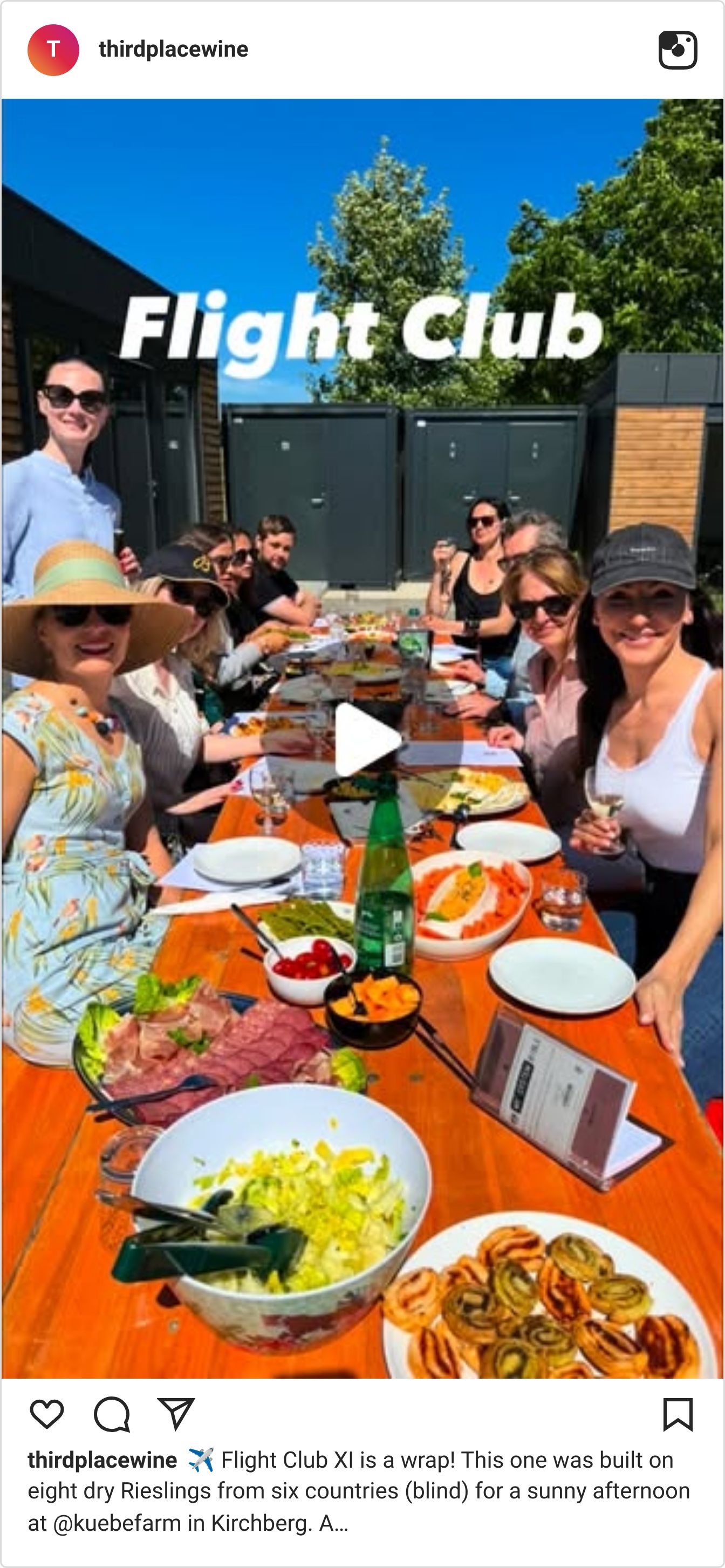
The “Riesling from Around the World” Flight Club on 13 June was a success! Luna made her debut and… some people even liked it!
And… if you were at Flight Club, you'll have found this on the table.
For everyone else—it's now available: a practical guide to reading German Riesling labels, including the VDP classification system.
It's my first digital product for Third Place Wine, and it’s something I wish I'd had when I first picked up a bottle of German Riesling and tried to decipher the label.
If you want to understand what's in the bottle before you buy, you’re going to want to have this on hand.
What's next
Aperitivo! (9 July): The third edition of Aperitivo!, the quarterly collaboration I do with Flûte Alors!, is all about rosé for people who don’t like rosé. I’ve curated a mini flight to help people discover not only how fabulous rosé Champagne can be, but also to help them discover their preferred style. More info on the Events page. See you there!
Thesis: I’ll be turning my attention back to thesis, which has suffered greatly these past months, but will endeavor (per ushe) to keep in touch here, through the WhatsApp group, event email list, and course my socials—join me on Instagram @ThirdPlaceWine.
If you want to join the WhatsApp group and/or the event email list, simply reply to this email.
Support the newsletter
Third Place Wine is an after‑hours project squeezed in between work, study, and my very fragile sleep schedule.
If you look forward to these emails, a one‑time contribution is a lovely way to say “keep going” and helps me keep sharing, experimenting, and growing our wine community.
And if you know one person who loves wine and would enjoy this, forward it to them.
